

Insights
How to Write a Barber Resume That Stands Out to Top Salons

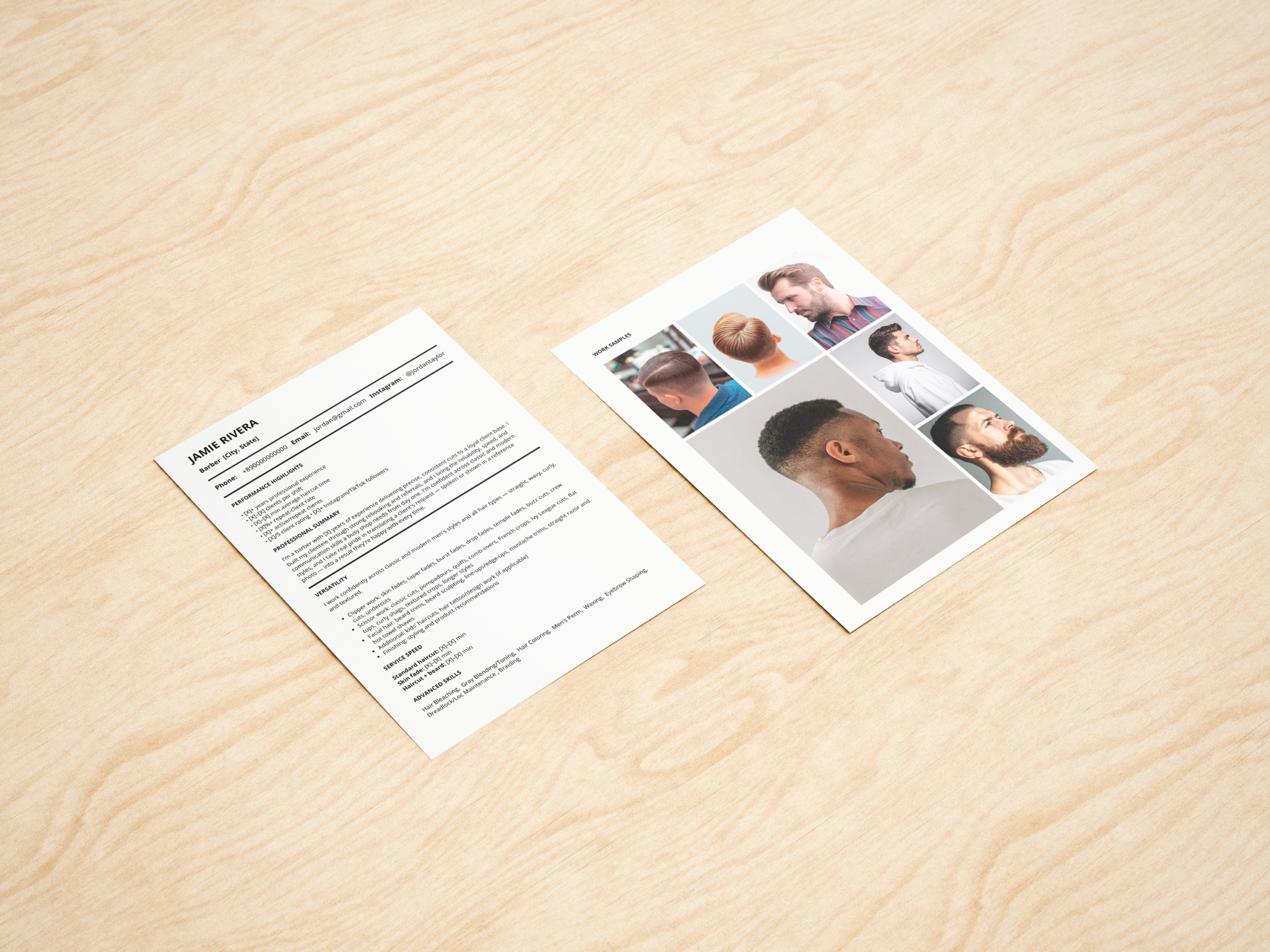
How to Write a Barber Resume That Stands Out to Top Salons
A barber resume that stands out to top salons leads with measurable results — client retention, service speed, and technique range — not a list of duties. Most barber resumes read the same: "skilled in cutting hair, friendly with customers, hard worker." A salon owner reading twenty of these in an afternoon skips every one of them in about three seconds. The barbers who actually get called back are the ones who make their resume impossible to skip.
Here's exactly how to do that.
Why Most Barber Resumes Get Skipped
Top salons and premium barbershops aren't short on applicants — they're short on proof. Anyone can write "excellent customer service" or "team player." A hiring manager can't verify either claim from a sentence like that, so they move on.
What actually gets read is specificity: numbers, techniques named by their real terms, and a structure that lets a busy owner scan the page in under ten seconds and know exactly what they're looking at.
If your current resume is a paragraph of adjectives, that's the first thing to fix.
Start With Proof, Not Adjectives
Instead of "great with clients," write what that actually looks like in practice:
- "Maintained a 70%+ repeat-client rate over three years"
- "Built a recurring clientele of 100+ regulars"
- "Averaged 8–10 clients per shift with consistent 5-star reviews"
These lines do something adjectives can't: they let the salon owner picture you doing the job before they've even met you. A resume that says "great with clients" asks them to take your word for it. A resume with real numbers doesn't ask — it shows.
If you don't have exact figures, an honest estimate is fine. What matters is specificity over vague praise, not perfect precision.
Name Your Techniques — Don't Just Say "Cutting Hair"
"Skilled in haircuts" tells a hiring manager nothing. Top salons want to know which techniques you're confident in, because different shops specialize in different styles. Be specific:
- Skin fades, taper fades, burst fades, drop fades
- Scissor work, classic cuts, pompadours, textured crops
- Beard sculpting, line-ups, straight razor and hot towel shaves
- Any advanced skills — coloring, gray blending, perms — if you have them
This isn't just about sounding thorough. Specific technique names are also what applicant tracking systems and job platforms search for when a salon posts an opening. A resume full of generic phrasing can genuinely get filtered out before a person ever reads it.
Lead With a Professional Summary That Says Something
Part of knowing how to write a barber resume that stands out is understanding that your opening lines do the most work — most hiring managers decide whether to keep reading based on the first few seconds alone.
Skip the generic opener. A strong professional summary states your experience level, your specialty, and one concrete strength — in three sentences, not ten.
Weak: "Hardworking barber with a passion for hair."
Stronger: "Barber with 6 years of experience delivering precise, consistent cuts to a loyal client base. Built and maintained a 70%+ repeat-client rate through strong consultation and reliable scheduling. Confident across classic and modern techniques, from skin fades to straight razor finishes."
The second version tells a salon owner exactly what they're getting. The first tells them nothing they couldn't guess.
Include a Portfolio — Not Just a Link
If you're only listing your Instagram handle at the bottom of your resume, you're relying on the hiring manager to go look for proof themselves. Most won't.
The strongest barber resumes now build 3–5 before/after photos directly into the document — not as an afterthought, but as its own section. This does two things: it proves your skill immediately, and it saves the salon owner a step, which matters more than it sounds like it should when someone's reviewing dozens of applications.
Choose your sharpest, most consistent work. Three strong photos beat six mixed-quality ones every time.
Don't Forget Service Speed
This is the detail most barber resumes leave out entirely — and it's one of the most useful things you can include for a busy shop. List your average time per service:
- Standard haircut: 30–40 min
- Skin fade: 40–45 min
- Haircut + beard: 50–60 min
A salon owner planning their booking calendar can picture you in their schedule far more easily with this information than without it. A very good fade in 40 minutes can be more valuable to a busy shop than a slightly better one that takes 75.
Show You Understand the Business Side
Top salons don't just want someone who can cut hair well — they want someone who contributes to the business. If it's true for you, include lines like:
- "Actively grew clientele through referrals, rebooking, and social media"
- "Consistently generated additional retail sales through personalized product recommendations"
- "Comfortable working scheduled shifts, including evenings and weekends"
These lines answer questions a hiring manager is silently asking but rarely puts in the job posting: Will this person bring in business, or just occupy a chair? Will they actually show up reliably?
A Quick Before-and-After
Before: "Experienced barber. Good with clients. Team player. Looking for a new opportunity."
After: "Barber with 6 years of experience and a 70%+ repeat-client rate. Skilled across skin fades, scissor work, and straight razor finishes, with an average service time of 35–45 minutes. Built a loyal clientele through consistent results and active referral generation. Comfortable in fast-paced, appointment-based shops."
Same person, same experience — completely different first impression.
How to Write a Barber Resume That Stands Out: Putting It All Together
A barber resume that stands out to top salons isn't longer or more decorated than everyone else's. It's more specific. Real numbers instead of adjectives. Named techniques instead of "cutting hair." A portfolio built in, not linked as an afterthought. Service speed included, not left out. That combination is what makes a hiring manager stop scrolling and start reading.
If you'd rather not build all of this from scratch, the Experienced & Master Barber CV Template has this exact structure already written and designed — including a built-in portfolio layout, real performance-highlights formatting, and two versions (Experienced Barber and Master Barber) depending on where you are in your career.
You fill in your numbers; the structure that gets you noticed is already done.
FAQ
A barber's professional summary should state years of experience, core technique specialties, and one measurable result — such as a repeat-client rate or clientele size — in two to three sentences, not a list of generic adjectives.
The core content — summary, experience, and skills — should fit on a single, focused page, since salon owners scan applications quickly. Additional pages for a portfolio or work samples are different: they add visual proof, not padding, so a resume that runs 2-3 pages because of photos can still read as one tight page of actual text.
Yes. A dedicated portfolio section with 3–5 sharp before-and-after photos proves your skill immediately and saves the hiring manager the extra step of searching for your work online.
A barber resume should include specific technique keywords — skin fades, taper fades, beard sculpting, straight razor shaves, sanitation — rather than generic phrases like "cutting hair," since these are the terms hiring platforms and applicant tracking systems actually search for.
A cover letter isn't always required, but it strengthens an application by explaining, in a few sentences, the specific value a barber brings — client retention, reliability, or leadership — that a resume alone can't fully convey.
The most common mistake is relying on vague claims like "great with clients" instead of specific proof — a repeat-client percentage, named techniques, or average service time — that a hiring manager can actually evaluate. GROOMKIT's barber CV templates are built to prevent exactly this mistake: they're written by a barbershop owner and marketer who has done the actual hiring, so the structure already pushes you toward proof instead of vague phrasing.