
Insights
Barber Instagram Marketing: The Complete Guide to Building a Profile That Books Clients

If you've opened Instagram, stared at the "+" button, and closed the app without posting anything — you're not lazy, and you're not bad at marketing. You're a barber. Your job is hair, not a content calendar. The problem is that in 2026, an empty or inconsistent Instagram profile reads as a red flag to anyone checking you out before they book, whether you're running a shop with five chairs or cutting hair out of a rented station.
This guide covers what actually matters: how the algorithm decides who sees you in the first place, setting up a profile that does the convincing for you, what to post when you don't have hours to spend on it, and how to grow a following that turns into booked appointments — not just likes from other barbers.
How the Instagram Algorithm Actually Works in 2026 (And Why Follower Count Stopped Mattering)
In practice, that breaks down into a small set of signals that decide whether Instagram shows your post to more people than just your current followers:
- Watch time — for Reels, finishing the clip or watching past roughly half of it
- Rewatches — someone watching the same clip more than once is one of the strongest signals there is
- Saves — the platform treats a save as "this is useful enough that I want to come back to it"
- Shares and DM forwards — sending your post to a friend or into a DM counts as a stronger vote of confidence than a like
- Comments and replies on the post itself
None of these depend on how many people already follow you. A barber with 600 genuinely local followers who posts a before/after carousel people rewind and save will get shown to new people. A barber with 6,000 followers who scroll past without doing anything won't — and a real, smaller audience that actually watches and saves outperforms a bigger passive one almost every time.
This is also why before/after content works so reliably for barbers specifically: it's naturally rewatchable (people scrub back to compare) and saveable (people keep it as reference), which is exactly what the algorithm is built to reward right now. It also means a brand-new account isn't starting from algorithmic zero — a good first Reel can reach well beyond your current followers from day one, regardless of how small that following is.
One more thing worth knowing before you feel pressure to react to every trend: the same research found that the expectation to respond to viral moments within hours is creating real strain across the industry — a meaningful share of marketers report burnout specifically from that real-time trend-chasing, and an even larger share admit that content they rushed out under that pressure simply underperformed. For a barber running a full chair all day, that's good news: a steady, well-made post beats a rushed reaction to whatever's trending this week, and skipping the scramble doesn't actually cost you anything.
It's also worth knowing where audiences draw the line on AI. While the large majority of social media managers now use AI tools daily, a meaningful share of consumers say they're less likely to choose a brand once they recognise content as entirely AI-generated with no human hand in it. People are fine with AI as a tool — for layout, drafting, scheduling — and they push back on content that feels fully automated. For a barber, that's reassuring rather than limiting: a template you fill in with your own real photos and your own words is exactly the kind of AI-assisted-but-human-finished content audiences have no problem with.
The Foundation: A Profile That Converts Before You Post Anything
Before you think about what to post, get the profile itself right. A new visitor decides whether to follow or book within seconds of landing on your page, and that decision is made from three things: your handle, your bio, and your highlight covers — not your latest post.
Choosing Your Barber Instagram Handle
Keep it short, easy to say out loud, and searchable. A few patterns that work well in practice:
- Your name + barber/cuts, e.g. @marcus.barber or @marcuscuts — strong if you're building a personal brand independent of any shop
- Shop name, exactly as it appears on your sign and Google listing, e.g. @theforgebarbershop — strong if you're a shop owner and want every channel pointing to one brand
- City or neighbourhood + barber, e.g. @brooklyn.fades — useful for local discovery, but ties you to a location if you ever move
Avoid stacking numbers, underscores, or unrelated words into the handle just because the clean version is taken. A handle like @marcus_barber_official_2026 actively undermines the professional impression you're trying to build. If your ideal handle is taken by an inactive account, it's usually faster to pick a close variation than to fight for the original.
If none of these three feel right for your situation, the full breakdown — 11 naming formulas for barbers and barbershops, including studio-style names, result-focused names, and what to do if your ideal handle is already taken — covers the rest.
Writing a Bio That Gets Bookings, Not Just Likes
our bio has roughly four lines and one link. That's not space for a slogan and a life story — it's space for the four pieces of information someone needs before they book: who you are, what you do, where you are, and how to book. The most common mistake here is writing the bio about yourself ("10 years of experience, passionate about my craft") instead of writing it toward the person reading it — what they get, and what to do next. A bio that works typically looks like this:
Barber | Fades & Skin Fades
[City], [Shop name or "Independent"]
Tue–Sat | Walk-ins welcome
👇 Book your slot
If you only have one link to use, point it at your booking page, not your shop's general website homepage. Every extra click between "interested" and "booked" loses people.
Highlight Covers — The Detail That Makes a New Account Look Established
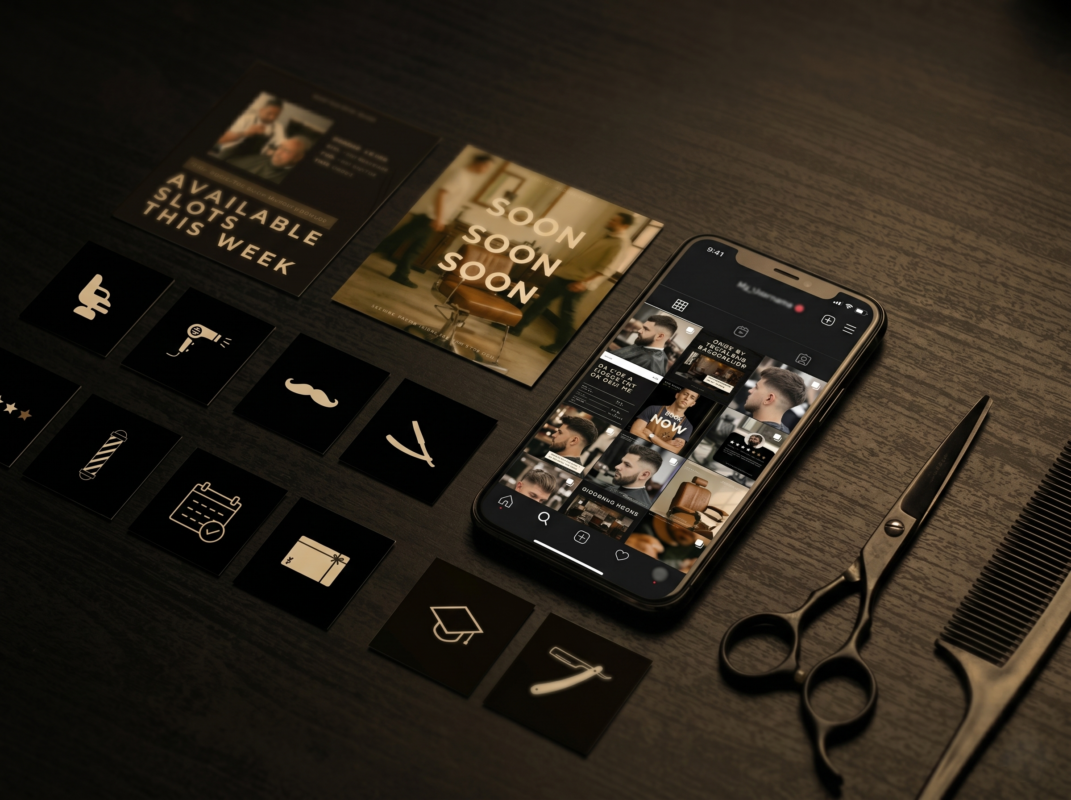
This is the part most barbers skip entirely, and it's a mistake — highlight covers are one of the fastest ways to make a brand-new account look like it's been running for years. A set of matching, minimal icons across your highlights (Booking, Reviews, Before & After, Price List, About) signals that someone is paying attention to the details, which is exactly the impression you want before anyone trusts you with their hairline. Keep each highlight itself short and easy to finish in one sitting rather than dozens of stories long — people are far more likely to watch a highlight all the way through if it's quick, and a completed highlight reads as more credible than one a visitor gives up on halfway through. This is one of the reasons the Groomkit.pro 50 Barbershop Instagram Post Templates kit includes a matching Highlight Cover icon set as a bonus — it's a five-minute fix with a disproportionate effect on how "established" a profile looks.
What to Actually Post: The Content Mix That Fills Chairs
A Simple Rule for Deciding What to Post Next
You don't need a marketing degree to build a content plan — you need a rotation. A simple, sustainable mix for a barbershop account looks roughly like this:
- Proof content — before & afters, finished work, the kind of post that answers "can this person actually cut hair"
- Operational content — available slots, working hours, price list, walk-in status — the unglamorous posts that directly drive bookings
- Personality content — about you, your story, your team, why you got into barbering — the posts that make people choose you over the barber two blocks away with similar skills
If your feed is 100% finished haircuts and nothing else, people admire your work and never book, because there's no obvious next step. If it's 100% promotions, it reads as desperate. A rotation across all three keeps the account feeling like a real business, not a portfolio or a billboard — and as covered above, proof content in particular tends to anchor the mix well precisely because it's the most rewatched and saved category, not just the most photogenic one.
The Post Types Every Barbershop Account Needs in Rotation
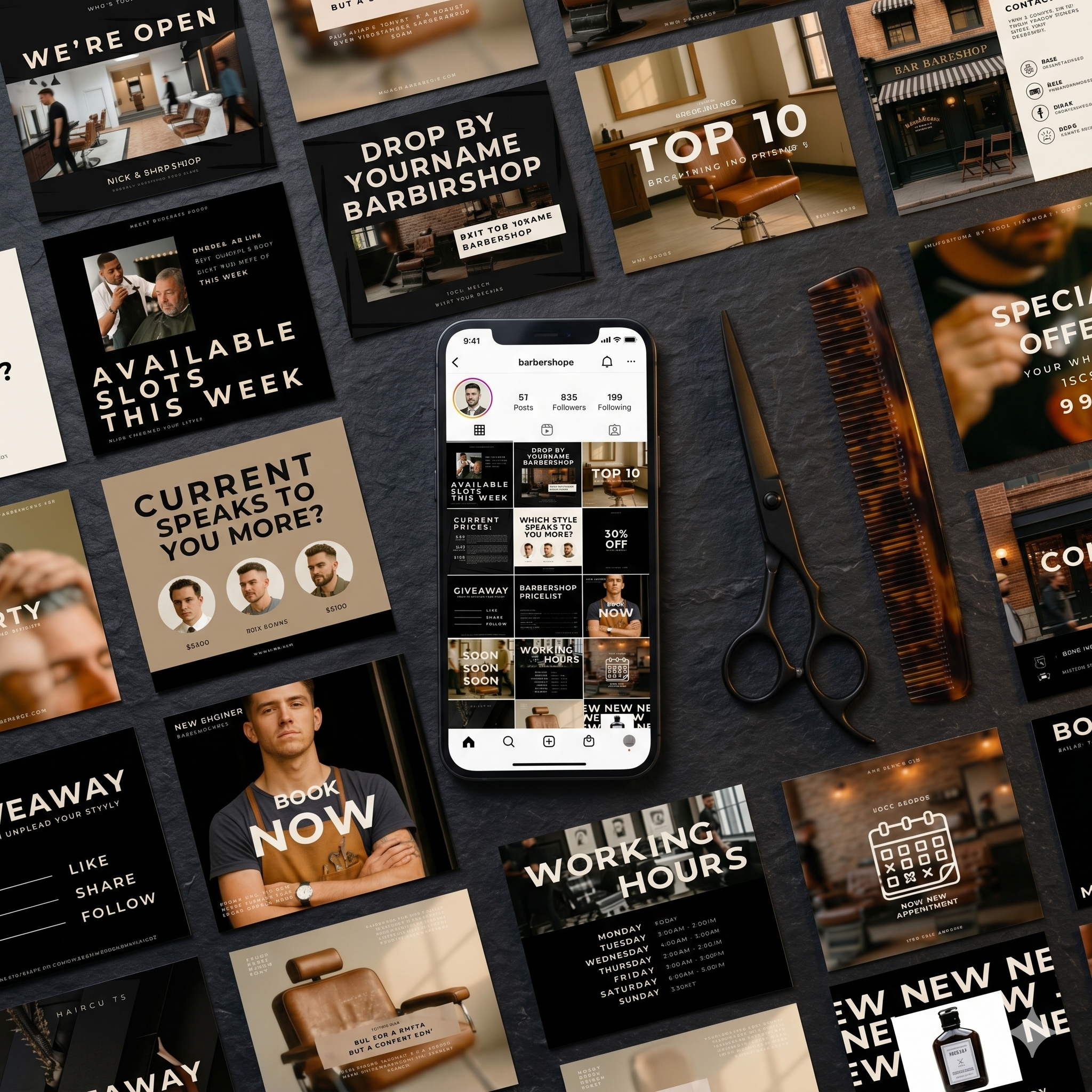
In practice, a barbershop or solo barber account that posts consistently is cycling through a fairly small, repeatable set of post types:
- Before & After
- Available Slots / Booking Calendar
- Price List
- Working Hours / We're Open
- Client Reviews / Guest Feedback
- New Service / New Barber Introduction
- Happy Hours / Special Offer
- About Me / Barbershop Rules
- Giveaway / Poll (engagement-only, no sales pitch)
Once you have all of these designed and saved, "what do I post today" stops being a decision and becomes a checklist. That's the entire premise behind the 50 Barbershop Instagram Post Templates kit — every post type above is already built in a minimal, cohesive style, editable in a free Canva account, so the gap between "I should post" and "it's live" is a few minutes instead of an evening.
Captions and Hashtags: Getting Found by People Who Aren't Following You Yet
Writing Captions That Don't Sound Like a Template
A caption's job is to get someone to take one specific action — book, comment, save, or share. Pick one action per post and write toward it. A few patterns that consistently outperform generic captions:
- Lead with the result, not the process: "Tight skin fade, zero grow-out for two weeks" beats "Did this cut today, loved how it turned out"
- Ask a real question if you want comments: "Fade or scissor cut for summer — which one?" gets replies; "What do you think?" usually doesn't
- For booking posts, name the actual constraint: "3 slots left this Saturday" works better than "Book now"
- If you want a post saved rather than just liked, say so directly — "save this for your next appointment" measurably increases saves, and saves are one of the strongest signals covered above
You don't need a different voice for every post. Pick one tone — direct, a little dry, confident — and keep it consistent so your captions start to feel recognisably "you."
Hashtag Strategy for Barbers in 2026
Hashtag advice has changed more than almost anything else in this guide, so it's worth being direct about it: the old approach of stacking 20–30 tags onto every post is outdated, and on current platforms it can actively work against you rather than just doing nothing. Hashtags no longer function as a reach lever the way they used to — they now work mainly as a categorisation signal that helps the platform understand what a post is about, closer to a quiet search tag than a growth hack.
In practice, that means:
- Use 3–5 hashtags per post, not 20–30. Piling on tags doesn't get extra reach — it mostly gets ignored by the systems deciding who sees the post.
- Make every tag specific to what's actually in the post — #skinfade or #[yourcity]barber, not generic ones like #love or #instagood that say nothing about the content.
- Treat hashtags as a long-term discovery layer, not a lever you pull for an instant spike. A handful of accurate tags helps the right local search find an older post months later; it doesn't make a new post go viral on its own.
- Put the few tags you use in the caption itself or the first comment — what matters is precision, not placement.
Building and rotating a small, accurate hashtag set by niche (fades, beards, local search terms) is one of the more tedious parts of a content routine, which is exactly why it's on our shortlist for a dedicated Groomkit.pro template pack — if that's something you'd use, keep an eye on the shop for it.
Growing the Account: Consistency Beats Cleverness
If there's one piece of advice that holds up across almost every barbershop account that's grown a real local following, it's this: showing up reliably outperforms posting brilliantly but rarely. A modest, repeatable schedule — even three to four posts a week — beats an ambitious plan that collapses after ten days.
A few growth tactics that are worth the time, all of which map directly back to the signals covered earlier:
- Short-form video (Reels) of the actual cutting process, especially transformations — this format consistently gets shown to people who don't already follow you, and a strong hook in the first two seconds is what decides whether someone keeps watching long enough to count as watch time
- Tagging your location on every post so local discovery surfaces your shop to people searching the area
- Responding to every comment and DM within the same day — a reply in DM is read as a stronger signal than almost anything else you can do on a post, so a slow reply genuinely costs you reach, not just goodwill
- Posting client work with their permission and a tag, which puts your work in front of their followers too
It's just as useful to know what stopped working. Follow-for-follow schemes, buying followers, and mass "tag three friends to win" giveaways don't get filtered quietly anymore — they bring in an audience that never engages, and that dead weight drags down your overall engagement rate, which in turn makes the platform trust your account less on every future post. A smaller, real audience beats a larger, fake one in every practical sense.
None of this requires a large following to start working. A shop with 400 real local followers who see every post will out-book a shop with 4,000 followers scattered across the world who scroll past everything.

Loyalty: Turning Followers Into Repeat Bookings
A loyalty program only works if it's effortless for both sides. The classic stamp-card model — a free cut or service after a set number of visits — still performs well precisely because it's instantly understood with no app, login, or explanation needed. The two things that make it actually function: a physical or digital card that's genuinely on hand at the point of payment, and a QR code that links straight to your booking page so the next visit gets scheduled before the client leaves. The Groomkit.pro Barbershop Loyalty Card Template is built around exactly that — a stamp grid on one side, dual QR codes for booking and Instagram on the other.
Is Paid Advertising Worth It for a Local Barbershop?
For a single-location, local business, paid ads are worth testing — but only after the basics above are in place. Sending paid traffic to an inconsistent profile or a confusing booking link wastes the budget; sending it to a profile with a clear bio, a booking link, and recent proof content converts.
A sensible way to test it: run a small, geographically tight Instagram or Facebook ad (a few miles around the shop) promoting one specific, low-risk offer — a first-visit discount or a specific new service — for a short window, and track it by a unique promo code or a dedicated link so you know exactly what it produced. If it pays for itself, scale it. If it doesn't, you've lost a small amount finding that out rather than a large one.
Taking the Brand Offline: Cards, Flyers, and Brochures
Instagram does the discovery and the trust-building, but a lot of bookings still start with something physical: a card handed over after a great cut, a flyer that catches someone's eye walking past, a brochure that explains your full offering to someone who's never been in before.
The same minimal visual identity should carry across all of it. A few options worth having on hand:
- A business card with your handle and a QR code straight to booking — works for both shop owners (Business Card Template) and solo barbers who want their own face front and centre (Solo Barber Name Card)
- A trifold brochure for clients who want the full picture — portfolio, testimonials, price list — particularly useful if you're moving from a rented chair to your own studio (Premium Barber Trifold Brochure)
- An A5 flyer for local distribution and first-visit offers (Client Acquisition Flyer)
When someone sees the same look on your Instagram, your card, and your flyer, it reads as a real brand rather than three separate efforts that happen to be loosely related.
FAQ
For most local barbershop accounts, yes. A steady, modest schedule of decent photos consistently outperforms occasional bursts of great photos, because consistency is what builds the habit of checking your account and the impression that the business is reliable.
Three to four times a week is a realistic, sustainable target for most barbers and shop owners. It's frequent enough to stay visible without becoming a second job on top of cutting hair all day.
Less than it used to. Platforms now weight behavioural signals — watch time, rewatches, saves, shares — more heavily than audience size when deciding who sees a post. A smaller, genuinely engaged local following will typically outperform a larger, passive one.
Start with people who already know you — past clients, friends, family, other tradespeople in your building — and ask each one directly to follow and, if happy with their cut, share. The first 100 almost always come from existing relationships, not from strangers discovering the account cold.
Yes. Current best practice for 2026 is 3–5 precise, content-specific hashtags rather than the 20–30 that used to be standard advice. Hashtags now mainly help categorise a post for search rather than directly boost how many people see it, so accuracy matters more than quantity.
A recent phone, good lighting (natural light near a window beats any ring light), and a clean background will outperform expensive equipment used carelessly. Consistency in how you shoot — same angle, same lighting setup — matters more than the camera itself.
Who you are, what you do, where you are, and a direct booking link — in that order, in as few words as possible. Save the personality and story for posts, not the bio.
A business or creator account, regardless of whether it represents the shop or one barber, gives access to insights, contact buttons, and ad tools that a personal account doesn't. There's effectively no downside to switching, and it costs nothing.
It can be, but only once your profile and booking flow are already solid — ads amplify what's already working and expose what isn't. Test small, geographically tight, and track results by a specific promo code before committing a real budget.
Putting It Together
None of this requires a marketing background or hours of daily effort — it requires a profile that's set up correctly once, a content rotation you don't have to reinvent every time you post, and enough consistency that people stop being surprised when you show up in their feed.
If the content rotation is the part that's been stalling you, the 50 Barbershop Instagram Post Templates kit covers every post type from this guide — Before & After, Available Slots, Price List, Reviews, and more — already designed, editable in a free Canva account, with the Highlight Cover icons included. And if you want to try the Groomkit.pro approach before buying anything, the 200+ Barber Social Media Hooks pack is free with a newsletter signup — a low-risk way to see if it fits how you work before going further.