Insights
Business Cards Still Work in 2026 — Here’s the Proof
Do Business Cards Still Work in 2026? (Barber Edition)
Yes — business cards still work in 2026, and for barbershops specifically, they outperform most digital-only marketing. Cards convert in-person interest into bookings at a much higher rate than a website visit alone, and when paired with a QR code linking straight to online booking, they close the gap between "I like this barber" and "I just booked a cut" in a single scan.
What running a barbershop taught me about how easily people forget
With over a decade in marketing and service-industry business — running a branding agency, and now operating a small barbershop chain in Warsaw — if there's one thing I've learned, it's this: a client liking you is not the same as a client coming back.
We live in a world where people are hit with hundreds of ads, posts, and notifications a day. Somewhere along the way, our brains got good at tuning almost all of it out. So when I hear a barber tell a client "just find me on Instagram," I already know there's about a 90% chance that client never comes back.
Being visible isn't the same as being memorable. In our experience, it takes something like seven real touchpoints before someone interested actually becomes a paying, returning client. One nice haircut and one Instagram follow rarely gets you there.
Acquiring a new client is always expensive. But what costs us the most is losing the clients we already spent so much time and money bringing in — the ones who don't come back after their first visit. Someone walks out of the chair completely happy, says "I'll definitely be back," and a month later can't remember their barber's name. Or forgets exactly where the shop is.
Not because they didn't like it — life simply moves on, and we were just one of a hundred things competing for their attention that week.
We tried the obvious fix: book the next visit right there in the chair, before the client even leaves. We tell them, "You can always reschedule later" — and that genuinely helps. But a lot of clients still say no. They want to decide for themselves, on their own time. Which means we needed a tool that respects that choice — something that lets a person book whenever they're ready, without needing to remember our name, our address, or dig through old messages to find us.
That's where a physical card earns its place again. It doesn't compete for attention in a feed. And to retain a client this way, we don't need to spend energy and budget publishing content every single day — we invest in the card once, and it sits in a wallet or a bag until the exact moment it's needed.
Then it's right there. Nothing to search for. No trying to remember how the name is spelled. No scrolling through dozens of followed accounts.
There's one more small trick that noticeably changed our results: we stopped handing out a single card. Now we hand out two — one for the client, one "for a friend." It costs us almost nothing, and it turns every happy client into a natural source of referrals, without us ever having to ask anyone directly.
The other important shift was cutting the distance between "I want to book" and "I'm booked."
Not everyone wants to call — a lot of people actively avoid phone calls these days. But scanning a QR code and landing straight on the booking page takes a few seconds and almost no effort. The shorter that path, the more people actually finish booking instead of thinking "I'll do it later" — and then just forgetting.
And this isn't just a feeling. The data backs up exactly this picture.

What the numbers actually say
It's not just a two-shop observation — the "cards are dead" narrative doesn't hold up well under scrutiny:
- First impressions are still physical. A large share of people — 72%, according to research from the Statistic Brain Research Institute — form an opinion about a business based on the quality of its business card. On the flip side, roughly 39% say they'd think twice about a company whose card looks cheap or poorly made.
- Cards convert better than most digital touchpoints. Data compiled by card printing company MOO found that business cards convert prospects into customers at around 12%, compared to an average website conversion rate of just 2.35%. For a barbershop, that's the difference between someone walking away and someone actually booking a chair.
- Revenue impact is measurable. That same MOO research estimated that distributing 100 well-designed cards can generate roughly $5,000 in additional revenue — a number that lines up with how word-of-mouth and referrals actually drive most barbershop growth.
- Even industry owners still trust them. Close to 60% of small business owners consider business cards essential to growing their business, and 57% say cards remain a core part of their in-person marketing, despite having every digital tool available.
The pattern across all of this data is consistent: business cards aren't competing with digital marketing — they're the bridge that makes digital marketing actually convert.
Why QR codes changed the equation
The old objection to business cards was real: someone takes your card, it sits in a wallet or a drawer, and by the time they think about booking, they've lost it or forgotten why they kept it.
QR codes fixed that gap. Industry data shows that cards featuring QR codes or NFC technology see roughly 30% more engagement than cards without them — because the card no longer requires someone to remember anything. They scan, they land on your booking page, and the decision happens in the same ten seconds as the impulse.
For a barbershop, that means a card isn't just a way to be remembered — it's a direct line from "I like this cut" to "I have an appointment Thursday at 2pm."
What this means for your shop
If your current card is a leftover template from years ago, or you've been putting off getting one printed because it felt outdated, the data suggests the opposite is true: a clean, well-designed card with a working QR code is one of the highest-converting, lowest-effort marketing tools available to a barbershop in 2026.
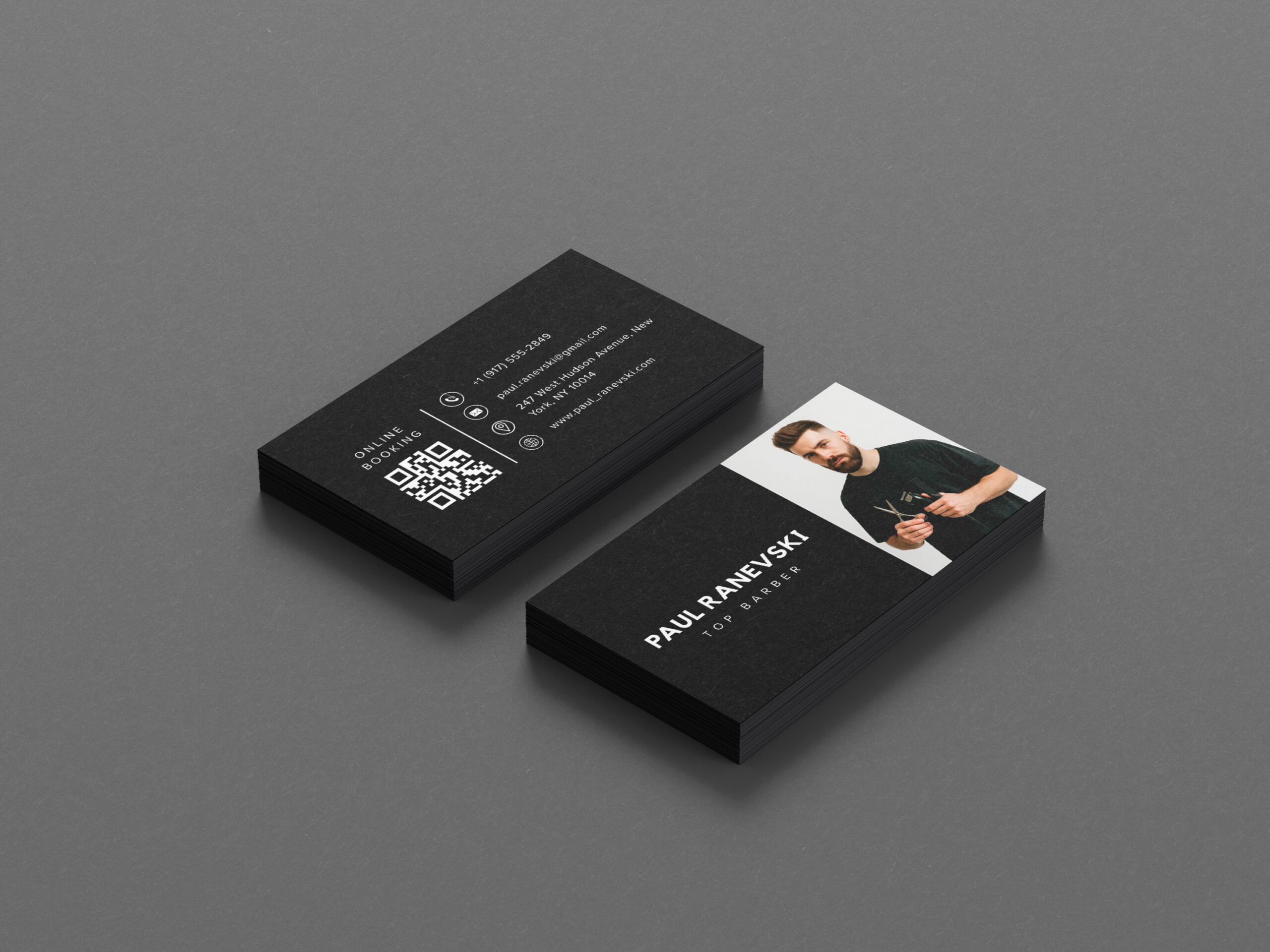
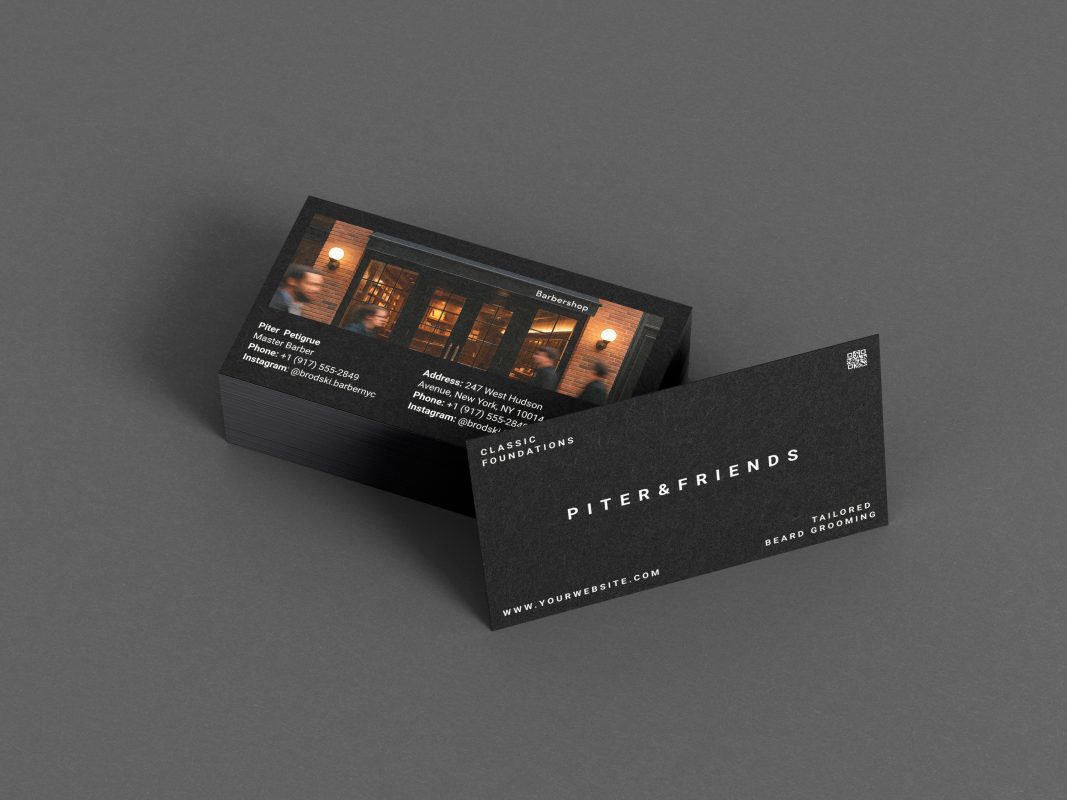
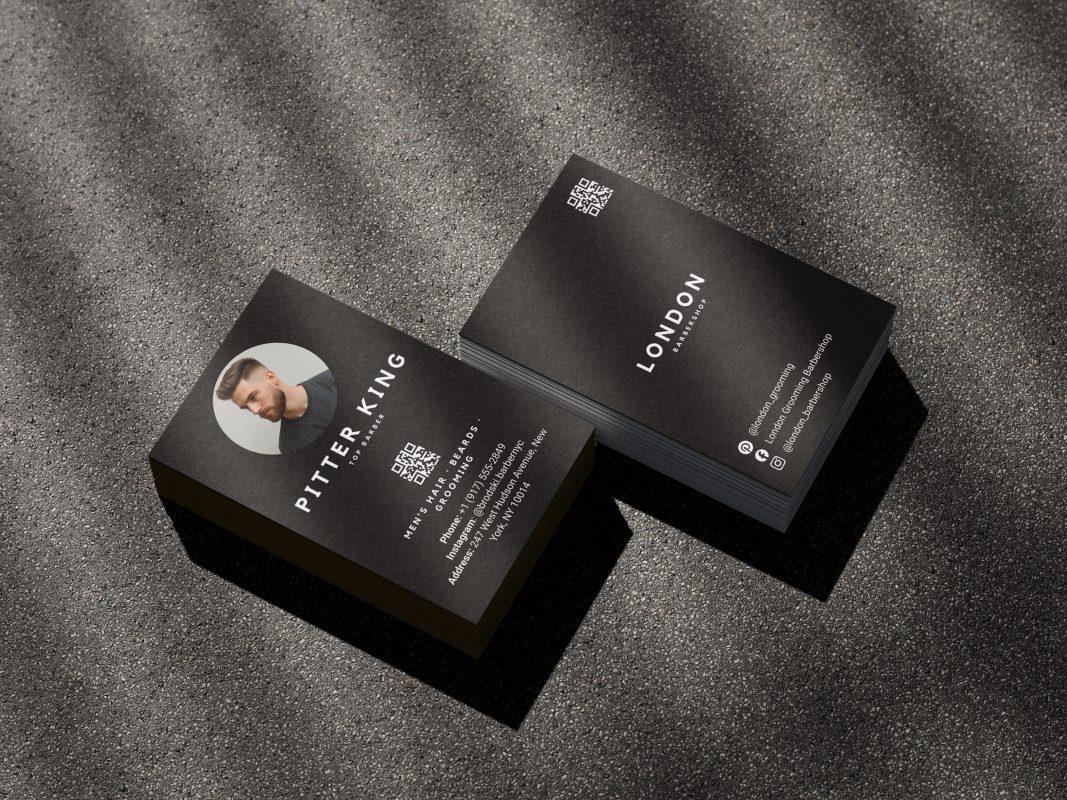
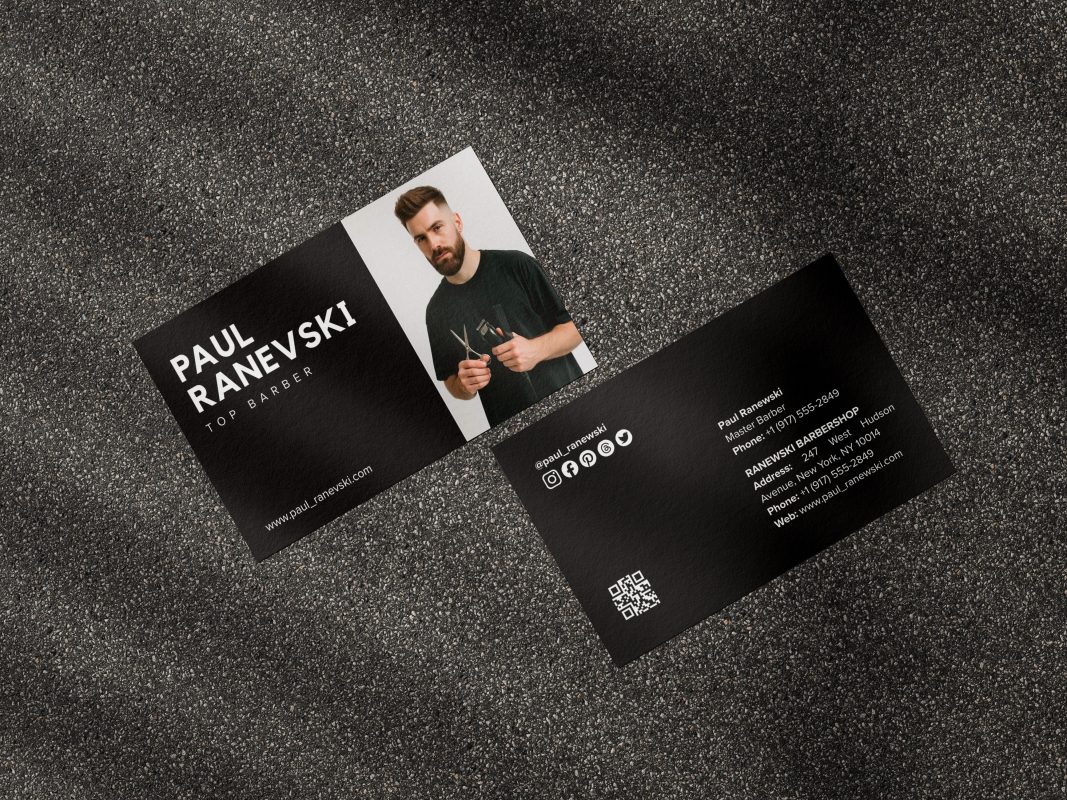
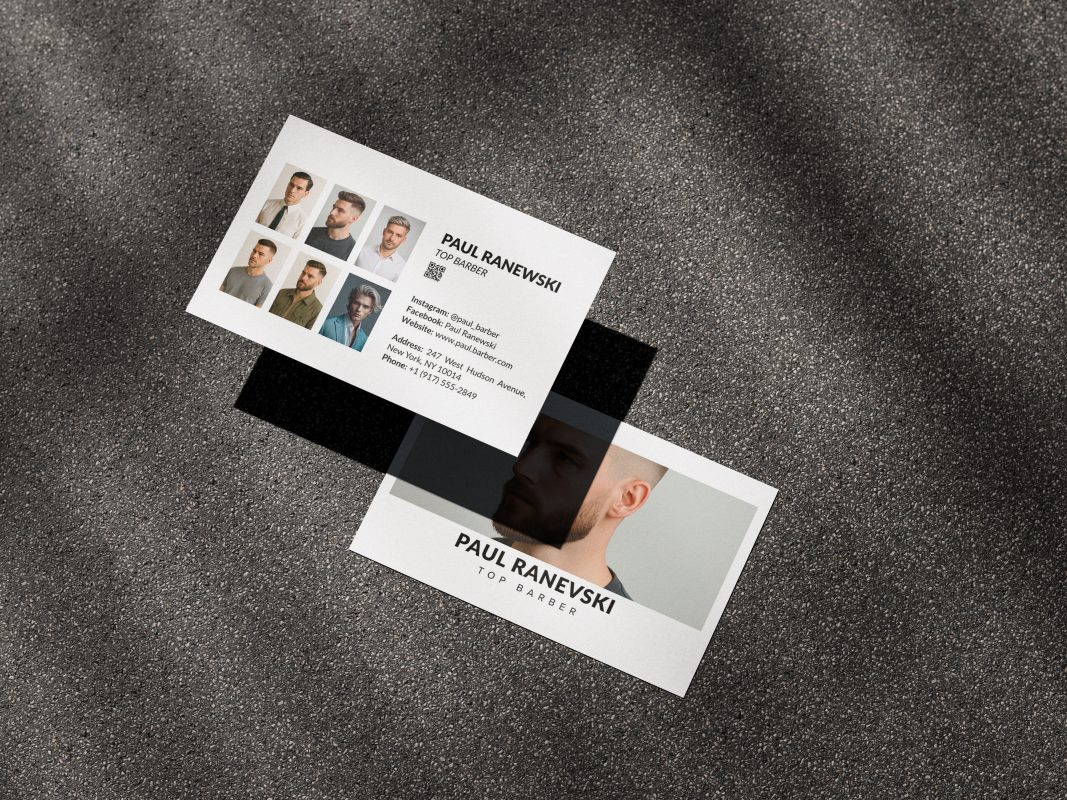
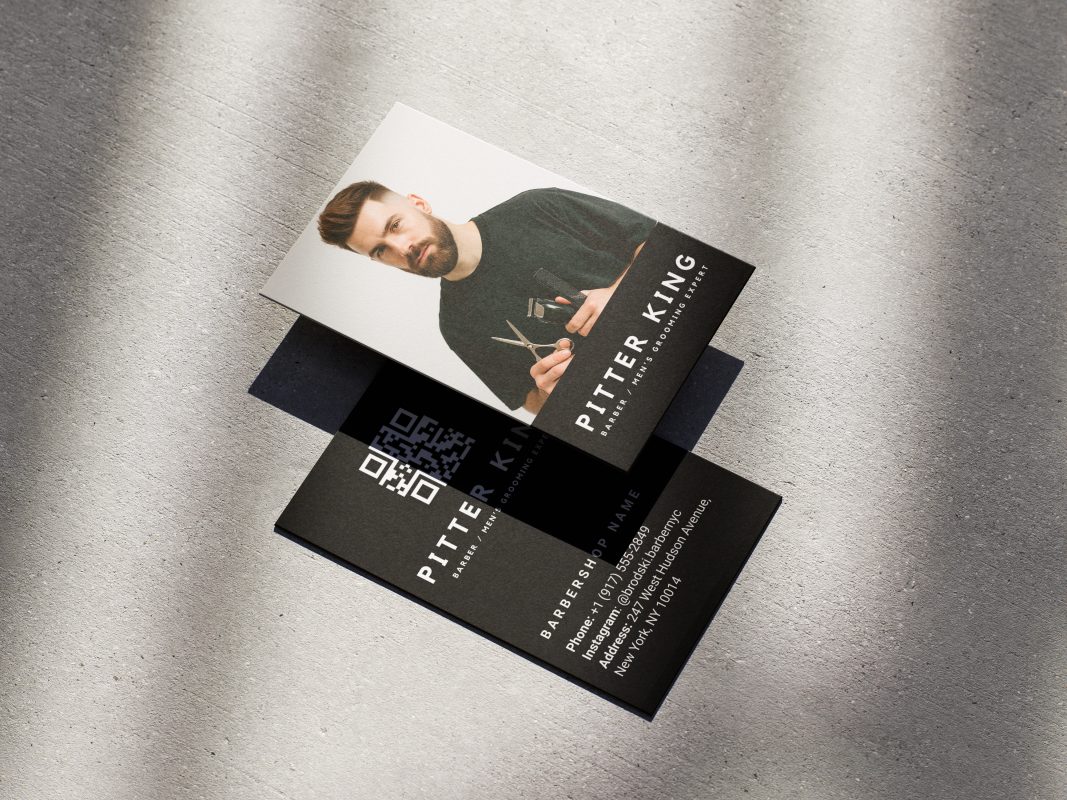
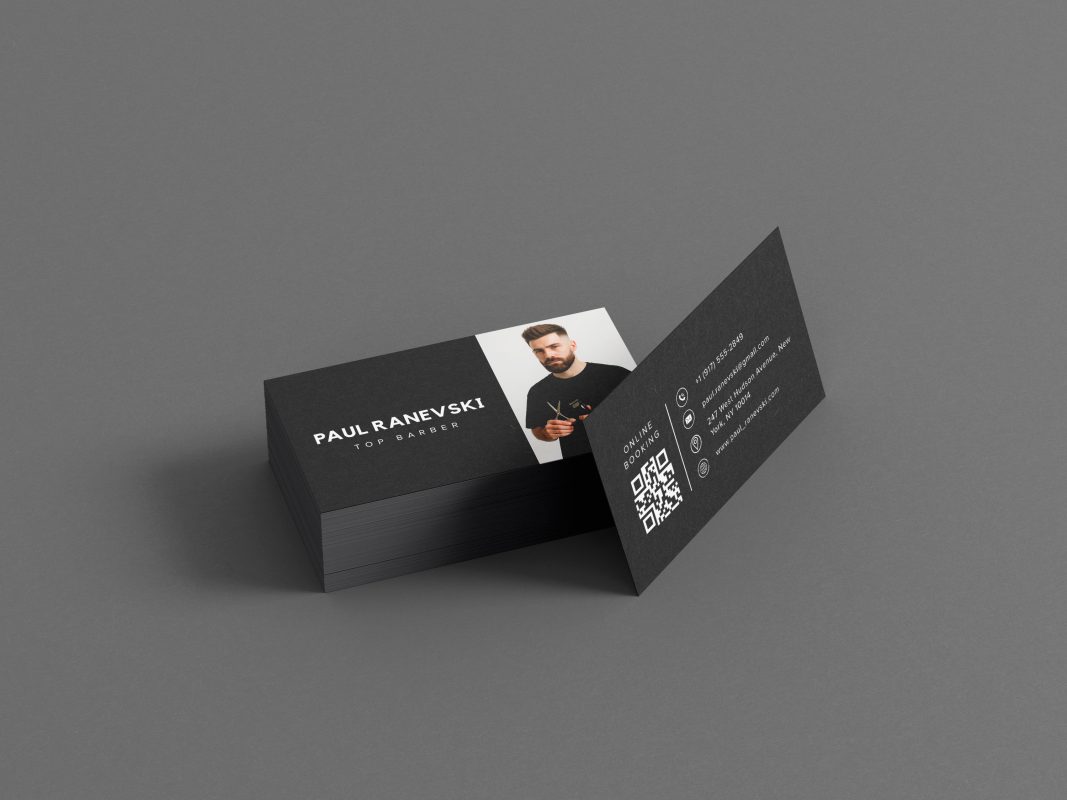
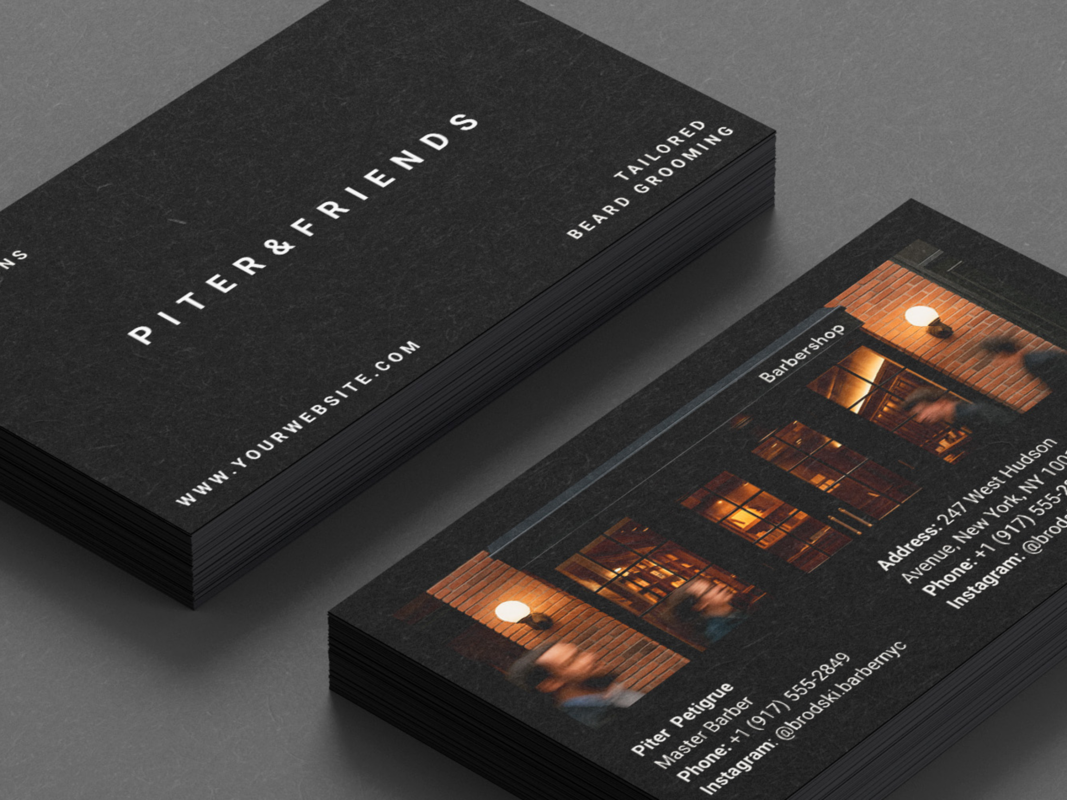
It doesn't need to be complicated. A minimal black design with your logo, your booking link built into a QR code, and your socials on the back covers everything a new client needs to go from curious to booked.
GROOMKIT makes editable, professional branding templates for barbers and barbershop owners — no design skills required.
-
Premium Minimalist Barbershop Business Card — Canva Booking Template
$8.00 + VAT
-
Barber Business Card Template — Double-Sided with Photo and QR Code
$8.00 + VAT
-
Barber Photo Business Card — Black Two-Sided with Social Icons and QR
$8.00 + VAT
-
Barber Portfolio Business Card — White Minimal with 6-Photo Work Grid
$8.00 + VAT
-
Solo Barber Name Card Template — Full-Face Photo with Bold QR Code
$8.00 + VAT
-
Freelance Barber Contact Card — Photo Front, QR Code and Website Back
$8.00 + VAT
FAQ
Yes. Data shows business cards convert at roughly 12%, compared to a 2.35% average website conversion rate, and 57% of small business owners still consider them essential to in-person marketing.
Yes — cards with QR codes or NFC features see about 30% more engagement than cards without them, since it removes the extra step of a client having to search for you later.
Consistency with your brand (same colors, fonts, and logo as your Instagram and storefront), a QR code linking directly to booking, and a design quality that signals attention to detail — since 72% of people judge a business by the quality of its card.
Based on industry research, distributing 100 well-designed cards can generate approximately $5,000 in additional revenue, making them one of the more cost-effective marketing tools available to independent barbers.
Sources
- Statistic Brain Research Institute, via PrintToBrand business card statistics roundup (2025)
- MOO research on business card conversion and revenue impact, via PrintToBrand (2025)
- Wave Connect business card statistics report (2025)
- UPrinting business card statistics (2025)